Below is a stop-motion animation of a ball bounce cycle created by Corey Tom.
This animation was created using a Logitech Webcam connected to a PC running SAM Animation. The ball was placed at various positions on the floor; Corey says that it was helpful to plan out the positions by making marks on the floor, just off-camera. There are only a handful of separate images; the sequence is repeated 10 times for 10 bounces.
This ball bounce cycle is very simple so you're encouraged to create something more interesting; you'll be graded on both the believability of the physical motion and on the creativity of your work. For inspiration, watch any of the episodes of Wallace and Gromit, for example:
http://www.youtube.com/watch?v=dy9QeosTh7w
Thursday, February 25, 2010


Wednesday, February 17, 2010
Video Analysis of Path of Action
Here is the original video reference, which has several jumps on the same clip. Most of the jumps are kind of wimpy but the first one is pretty good.

Here are some further examples from last semester:
http://terrychiem123.blogspot.com/2009/09/video-analysis-of-path-of-action.html
http://physicsofthedead.blogspot.com/2009/09/4-homework-5-video-analysis-of-path-of.html
http://kathleen-obrien1300.blogspot.com/2009/09/video-analysis-of-path-of-action.html
http://annaime.blogspot.com/2009/09/video-analysis-of-path-of-action.html
Below is the image showing the path of action for the jump as well as the graphs of the horizontal versus time and the vertical position versus time.

Notice that the graph of horizontal position is a straight line, which indicates constant speed in the horizontal direction. The graph of the vertical position is a parabolic arc, similar to the graph in the previous homework (track of a falling object), except that in this case you first rise and then fall back down. But notice how the rising motion is symmetric with the falling motion.
Finally, here is the video clip with tracking:
Here are some further examples from last semester:
http://terrychiem123.blogspot.com/2009/09/video-analysis-of-path-of-action.html
http://physicsofthedead.blogspot.com/2009/09/4-homework-5-video-analysis-of-path-of.html
http://kathleen-obrien1300.blogspot.com/2009/09/video-analysis-of-path-of-action.html
http://annaime.blogspot.com/2009/09/video-analysis-of-path-of-action.html
Wednesday, February 10, 2010
Tracker video analysis of falling
The image below shows the track of the falling ball, as obtained using the Tracker software.

The plot on the upper left is the horizontal position versus time. The graph should be a flat line because the ball does not move left-to-right but it's hard to mark the exact position so the graph shows some random variation.
The lower plot of the vertical position versus time is more interesting. Notice that this plot is a parabolic arc. There are about 16 frames from apex to impact and the 8th frame (half way down in time) is about a quarter of the distance from the apex to the ground. The frame rate in this clip is 30 fps so it takes just over a half second for the center of the ball to fall a height of about five feet (Corey Tom, who is dropping the ball, is 5 foot 9 inches tall).
Here are some examples from last semester:
Saturday, February 6, 2010
Video Reference
Here is the video reference for a falling object (as dropped by SJSU's own Corey Tom). This reference was shot using a Sony HD digital camcorder and recorded at 30 frames per second.
Thursday, January 28, 2010
Mini-Portfolio
Here are some examples of the "Mini-Portfolio" assignment (Homework #2):
http://christybecker.blogspot.com/2009/09/mini-portfolio.html
http://ryancanimation.blogspot.com/2009_08_01_archive.html
http://clamphysics123.blogspot.com/2009_08_01_archive.html
http://miyukianimationphysics123.blogspot.com/2009/08/mini-portfolio.html
http://artphysics123.blogspot.com/2009_05_31_archive.html
http://christybecker.blogspot.com/2009/09/mini-portfolio.html
http://ryancanimation.blogspot.com/2009_08_01_archive.html
http://clamphysics123.blogspot.com/2009_08_01_archive.html
http://miyukianimationphysics123.blogspot.com/2009/08/mini-portfolio.html
http://artphysics123.blogspot.com/2009_05_31_archive.html
Wednesday, January 6, 2010
Spring Semester 2010
If you are reading this blog then you're probably enrolled in Physics of Animation (Art / Physics 123). This blog is primarily used to post examples to help you with your homework assignments, which you'll be posting on blogs of your own. Most of the information you'll need about the course is found on the course website, http://artphysics123.pbworks.com/.
Your first homework assignment for the course will be to set up a blog of your own, which you'll use to post homework assignments and term papers. You'll find more info on this first homework assignment here.
The earlier posts on this blog are from the Fall 2009 semester; the course will be similar but not quite the same this semester. Nevertheless, the postings from last semester will give you a general idea of the kinds of assignments you'll be doing.
See you in class! Alej Garcia
Your first homework assignment for the course will be to set up a blog of your own, which you'll use to post homework assignments and term papers. You'll find more info on this first homework assignment here.
The earlier posts on this blog are from the Fall 2009 semester; the course will be similar but not quite the same this semester. Nevertheless, the postings from last semester will give you a general idea of the kinds of assignments you'll be doing.
See you in class! Alej Garcia
Monday, December 14, 2009
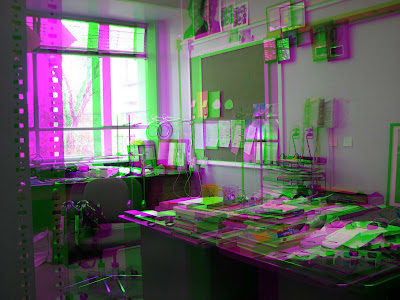
Stereo 3D photo
Below are some examples of stereo 3D photos, such as what you'd create for the extra credit assignment. This is my (messy) office seen as a green/magenta anaglyph image and as a red/cyan anaglyph image. See the course website for instructions on how to create such images in Photoshop.


Subscribe to:
Posts (Atom)
