If you are reading this blog then you're probably enrolled in Physics of Animation (Art / Physics 123) at San Jose State. I will be using this blog primarily to post examples to help you with your homework assignments, which you'll be posting on blogs of your own.
The earlier posts on this blog are from the Fall 2009 and Spring 2010 semesters; the course this semester will be similar but not exactly the same. Nevertheless, the postings from previous semesters will give you a general idea of the kinds of assignments you'll be doing. You will also find it useful to look at the blogs of students who took the course in the past two semesters. All the information and links you'll need about the course is found on the course website, http://artphysics123.pbworks.com/.
Your first homework assignment for the course will be to set up a blog of your own, which you'll use to post homework assignments and term papers. You'll find more info on this first homework assignment here.
See you in class! Alej Garcia
Friday, August 20, 2010


Sunday, May 9, 2010
Creating Stereoscopic 3D Images
The photo below is a Green/Magenta 3D anaglyph image of my (messy) office.


For the image below the photos were shifted to align the phone, which puts it at screen depth.

And for the image below the photos were shifted to put the bookshelf on the far left of the screen at screen depth (which essentially puts everything else inside the screen).

Last semester this assignment was different, in fact it was optional for extra credit. Here are some examples from last semester:
http://ryancanimation.blogspot.com/2009/12/stereo-3d-images-extra-credit.html
http://stevendalcanto.blogspot.com/2009/12/stereo-3d-photo.html
http://kathleen-obrien1300.blogspot.com/2009/12/stereo-3d-images.html
http://yolandaphysic123.blogspot.com/2009/12/stereo-3d-photo.html
Be sure to read the assignment carefully and include all the required photos. In fact, I recommend that you shoot five times more photos than you think you'll need because most photos do not make an effective 3D image. Furthermore, it's not uncommon to make errors, such as rotating the camera when repositioning it. Finally, be creative with your images and make them varied and interesting.
Thursday, April 29, 2010
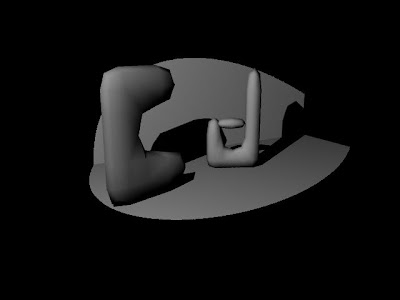
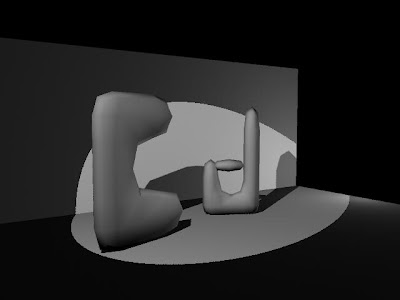
Lighting a Scene in Maya
One-Point Lighting (Single key light on the left casting strong shadows).
Two-Point Lighting (Additional fill light to soften the dark shadows)
Three-Point Lighting (Rim light behind the letters to accentuate the edges).
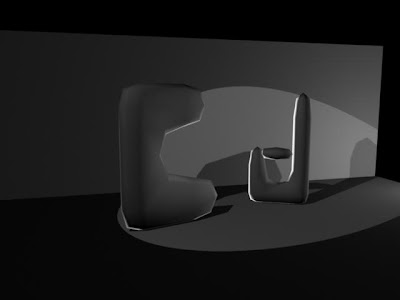
The images above were created by Candace Downey.
Here are some of the better ones from last semester:
http://stevendalcanto.blogspot.com/2009/12/lighting-scene-in-maya.html
http://christopherheckey.blogspot.com/2009/12/lighting-scene-in-maya.html
http://miyukianimationphysics123.blogspot.com/2009/11/lighting-scene-in-maya.html
http://ericart123.blogspot.com/2009/12/three-point-lighting-two-point-lighting.html
http://lain-yee.blogspot.com/2009/12/maya-initials-scene-and-lighting.html

Two-Point Lighting (Additional fill light to soften the dark shadows)

Three-Point Lighting (Rim light behind the letters to accentuate the edges).

The images above were created by Candace Downey.
Here are some of the better ones from last semester:
http://stevendalcanto.blogspot.com/2009/12/lighting-scene-in-maya.html
http://christopherheckey.blogspot.com/2009/12/lighting-scene-in-maya.html
http://miyukianimationphysics123.blogspot.com/2009/11/lighting-scene-in-maya.html
http://ericart123.blogspot.com/2009/12/three-point-lighting-two-point-lighting.html
http://lain-yee.blogspot.com/2009/12/maya-initials-scene-and-lighting.html
Wednesday, April 21, 2010
Building a Scene in Maya

Above is an example for this assignment (created by Candace Downing, so the letters are "c" and "d"). Your letters may be upper-case and/or lower-case; they may be a single object or several objects put together. Your scene can be fancier that this example but do not include any extraneous elements other than the floor, the wall in the background, and the two letters in the foreground.
Here is some of the best work from Fall 2009 semester:
http://christopherheckey.blogspot.com/2009/11/building-scene-in-maya.html
http://astrosplayhouse.blogspot.com/2009/11/building-scene-in-maya.html
http://physics123alanpasman.blogspot.com/2009/11/building-scene-in-maya.html
http://elizabeth-medina.blogspot.com/2009/11/building-scene-in-maya.html
http://samcriner.blogspot.com/2009/11/building-scene-in-maya.html
http://ryancanimation.blogspot.com/2009/11/building-scene-in-maya.html
Thursday, April 8, 2010
Science Fact or Cinematic Fiction
Here are links to three term papers from Fall 2009 semester that are examples for the second term paper assignment:
http://physicsofthedead.blogspot.com/2009/11/10-science-fact-or-cinematic-fiction-of.html
http://miyukianimationphysics123.blogspot.com/2009/11/second-term-paper.html
http://tirasuwan-artphysics123.blogspot.com/2009/11/science-fact-or-cenematic-fiction.html
http://physicsofthedead.blogspot.com/2009/11/10-science-fact-or-cinematic-fiction-of.html
http://miyukianimationphysics123.blogspot.com/2009/11/second-term-paper.html
http://tirasuwan-artphysics123.blogspot.com/2009/11/science-fact-or-cenematic-fiction.html
Saturday, March 20, 2010
Stop-Motion Character Animation
Here is an example of a stop-motion animation of a walk cycle done by Corey Tom.
The top three character animations last semester are these:
http://miyukianimationphysics123.blogspot.com/2009/10/stop-motion-animation_23.html
http://samdebey.blogspot.com/2009/10/stop-motion-animation.html
http://clamphysics123.blogspot.com/2009/10/stop-motion-animation.html
Note that the last one was a team effort; if you work as part of a team then be sure to include a shot breakdown, saying who did what.
Wednesday, March 17, 2010
Reverse Video Reference of Walking
Here are the top reverse video reference clips from last semester:
Clip A: Original Animation / Reverse Video Reference
Clip B: Original Animation / Reverse Video Reference
Clip C: Original Animation / Reverse Video Reference
Clip D: Original Animation / Reverse Video Reference
Clip E: Original Animation / Reverse Video Reference
Note that this semester the animation clips are different from last semester! For details on this semester's assignment, go here.
Subscribe to:
Posts (Atom)
